


Аз съм Пламена Попова и съм експерт продажби в агенция за езикови преводи „Олтранс“ от 2024 година. Завършила съм специалност „Лингвистика с бизнес администрация“, което ми позволява да насоча придобитите академични умения в областта на преводаческите услуги.
Работата в тази сфера изисква разбиране към клиента, умение за създаване на подходяща оферта според запитването и добра запознатост с институциите в България, занимаващи се с легализиране на документи.
Всяка година обработвам средно по 700 поръчки за превод и легализация - всяка една от тях е индивидуална и специфична.
Най-често имам запитвания за чуждестранни документи, които трябва да послужат в България. Спецификата при тях е, че те трябва да отговарят на определени условия преди да започнем с процеса „превод и легализация“.
Много клиенти се обръщат към нас за помощ, защото се сблъскват за първи път с преводи и искат точна и ясна информация. Моята цел номер едно е да бъда добре запозната с нуждите на всеки клиент, който се е свързал с нас, за да може той да остане доволен от предоставените услуги и да изградим взаимно доверие за бъдещи проекти.
Translation and Legalization of Banking Documents for International Use

Translation and Legalization of Banking Documents for International Use
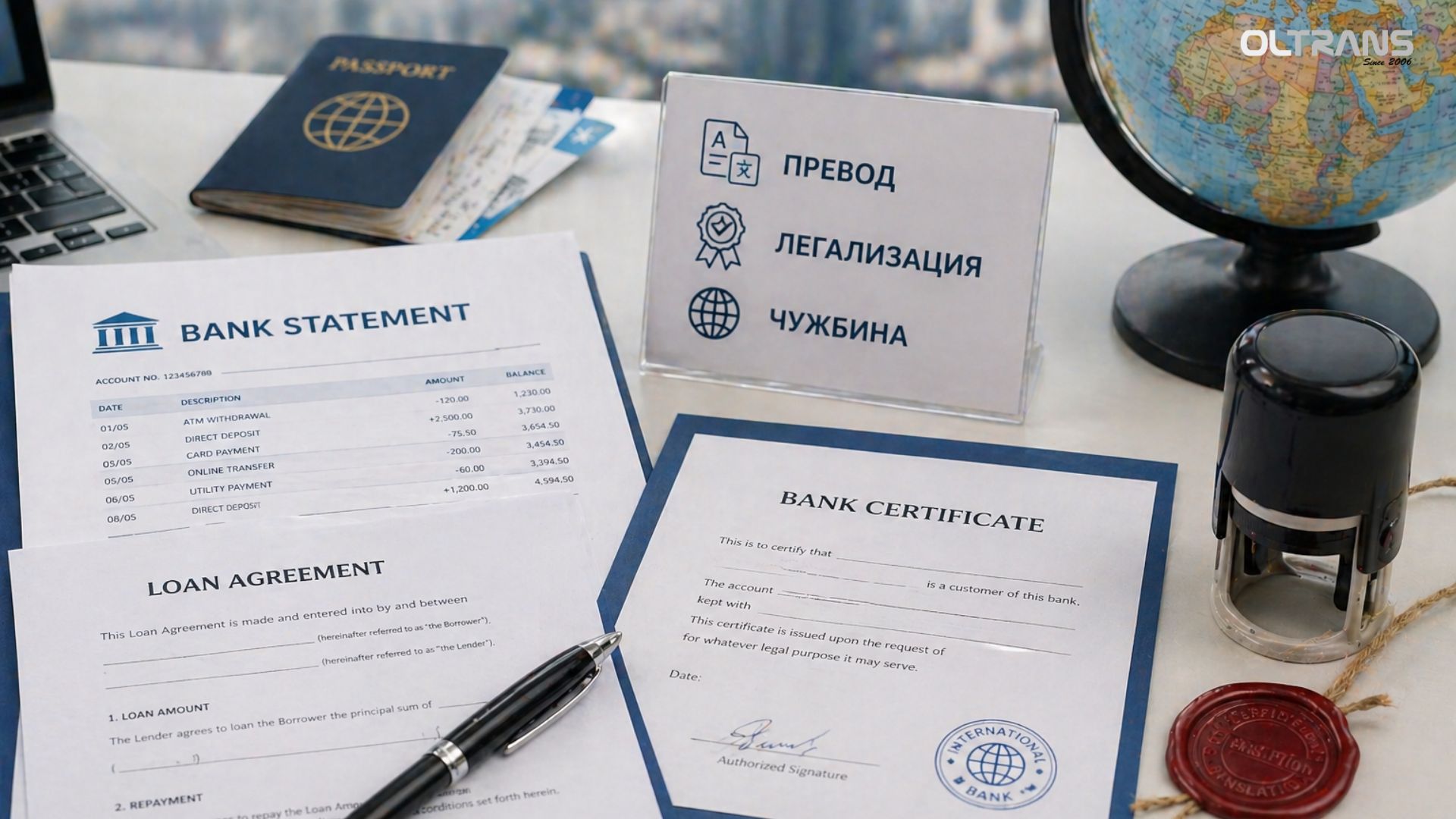
Banking documents are among the most frequently used in international transactions, employment abroad, education, or investments. They certify the financial standing of an individual or a company and are required in many situations – from opening an account in a foreign bank to proving financial solvency to a university or employer.
For them to be recognised outside Bulgaria, banking documents must go through a process of translation and legalisation. This is not merely an administrative formality – it guarantees that the document will be accepted by institutions and financial authorities abroad as authentic and valid.
Without proper translation and legalisation, even the most important document – such as a bank statement or a certificate of account balance – may be rejected, causing delays in transactions, denial of loans, or problems with university enrolment or starting a new job. (more…)
- Published in Language Services
Translating Documents for International Adoption

Translating Documents for International Adoption

International adoption is a long and emotional process that combines legal, administrative, and deeply personal aspects. For Bulgarian citizens who plan to adopt a child from abroad or to finalise a procedure started in Bulgaria, one of the most important steps is the proper preparation of documents.
These documents – birth certificates, court decisions, criminal record certificates, marriage certificates, medical records, and social reports – must not only be complete and accurate but also gain international legal validity. This is achieved through translation and legalisation.
The translation and legalisation of adoption documents are not mere formalities. They ensure that the documents will be accepted by institutions in another country – courts, social services, or administrative authorities. Without proper legalisation, the entire process may be delayed or even blocked, which can prove a serious challenge for families taking this important step.
In the following sections, we will look in detail at which documents require translation and legalisation, what procedures apply within the EU and beyond, the most common mistakes and how to avoid them, and how professional assistance can simplify the entire process. (more…)
- Published in Language Services
Translation and Legalization of Employment Contracts for Work Abroad

Translation and Legalization of Employment Contracts for Work Abroad

Working abroad is both a dream and a goal for thousands of Bulgarians seeking better pay, new opportunities, and professional growth. Yet before you can begin your job overseas, one of the most crucial requirements is the proper preparation of your employment contract. To have legal validity outside Bulgaria and be accepted by foreign institutions and employers, the document must undergo translation and legalisation.
The translation and legalisation of employment contracts are not just an administrative formality – they ensure that the document is authentic, understandable, and legally recognised in the country where you will be working. Without these steps, there is a serious risk that your contract may not be accepted, which could delay your start date or even create significant legal complications. (more…)
- Published in Language Services
Which Inheritance Documents Require Translation and Legalization?

Which Inheritance Documents Require Translation and Legalization?

Inheritance matters are often sensitive and complex, particularly when they need to be settled outside Bulgaria. An increasing number of Bulgarians own property, bank accounts, or investments abroad, and their heirs are faced with the necessity of proving their rights before foreign institutions.
In such cases, inheritance documents come to the forefront – death certificates, certificates of heirs, wills, notarial deeds, court decisions, and others. For these to be recognised abroad, they must undergo a process of translation and legalisation, which grants them legal validity outside Bulgaria.
It is important to note that the rules differ depending on the country. Within the European Union, procedures are simplified thanks to Regulation (EU) 2016/1191, which reduces bureaucracy and allows certain documents to be used directly once translated. In countries outside the EU, however – for example, Turkey, the United States, or Canada – an apostille, or even full consular legalisation, is often required.
Any omission or inaccuracy in preparation may lead to serious consequences: delays in court proceedings, blocked access to assets, or outright refusal to recognise inheritance rights. This is why heirs must be aware of which inheritance documents require translation and legalisation, and what exact steps must be followed. (more…)
- Published in Language Services
What Is Legalisation through Diplomatic Representation?

What Is Legalisation through Diplomatic Representation?

When Bulgarian documents need to be recognised abroad, a simple translation is often not sufficient. Some countries require an additional procedure – legalisation through a diplomatic representation, also known as consular legalisation. This process guarantees the authenticity of the document and ensures that it can be lawfully used before foreign authorities. (more…)
- Published in Language Services
What Is a Translation with an Accompanying Declaration and When Is It Used?

What Is a Translation with an Accompanying Declaration and When Is It Used?

When a document is translated—particularly for submission to government institutions, courts, or foreign authorities—a simple linguistic rendering is often not sufficient. What is required is additional confirmation that the translation is accurate and carried out by a qualified professional. This is where a translation with an accompanying declaration becomes essential: a tool that gives the work the status of an official translation and guarantees its reliability.
What Is a Translation with an Accompanying Declaration?
A translation with an accompanying declaration is a special form of translation in which the translator not only renders the text linguistically but also assumes personal responsibility for its accuracy. Alongside the translation, a written declaration is attached—this is a document in which the translator explicitly confirms that the translation is complete, faithful, and fully corresponds to the original. Such a declaration is usually signed by hand, and in some cases, a notarial certification of the signature may also be required to guarantee that the specific translator is legally accountable for the text.
In international practice, this type of service is often referred to as a certified translation or a sworn translation. Although the terms are similar, important distinctions exist depending on national legislation. In some countries, such as the United Kingdom, a certified translation involves a declaration from the translator or translation agency, without the mandatory requirement of notarial certification. In other jurisdictions, such as Spain or France, a sworn translation may only be carried out by translators who hold a special state-authorised status, and whose signatures are automatically recognised by public institutions.
In Bulgaria, the procedure has its own particularities. A translation with an accompanying declaration is usually prepared by a sworn translator registered with the Ministry of Foreign Affairs. Such a translator is included in an official list and is authorised to produce translations with legal validity. The declaration is attached to the translation and contains key elements: the translator’s details, details of the document, a statement of accuracy, and the date of completion. Depending on the requirements of the receiving institution, the translation may also be bound together with a copy of the original document in order to eliminate any suspicion of tampering.
The essential feature of this type of translation is that it gives the text an official and legally significant character. Without the declaration, the translation may be regarded as “regular” and might not be recognised by courts, universities, banks, or foreign institutions. With the declaration, however, trust is established: the content of the document is confirmed as accurately rendered and can therefore be relied upon for official purposes.
When Is a Translation with an Accompanying Declaration Used?
A translation with an accompanying declaration is required whenever it is necessary to prove that the translation of a document is official, accurate, and fully corresponds to the original. This is particularly important in situations where the correctness of the translation carries legal, educational, or financial consequences.
One of the most common situations is the submission of documents abroad. When a Bulgarian citizen applies for studies, employment, or marriage in another country, the institutions there usually require diplomas, certificates, and civil status records to be accompanied by an official translation with a declaration. In this way, universities, employers, or administrative authorities receive assurance that the submitted documents have been translated accurately and may be relied upon as legally valid.
Another example is judicial proceedings. If a piece of evidence or a document is drafted in a foreign language, the court will not consider an ordinary translation without certification sufficient. In such cases, the translator’s accompanying declaration is decisive, as it grants the translation official status and allows it to be admitted into the case as valid evidence.
A similar importance applies to banks and financial institutions. When applying for a loan, proving income, or conducting international transactions, it is often necessary to submit financial statements, contracts, or certificates issued abroad. For these documents to be recognised by banks, they must be translated and duly certified through an accompanying declaration.
This practice is also of essential importance in notarial proceedings. When a power of attorney, contract, or other legal transaction drafted in a foreign language must be entered, the notary requires the translation to be not merely a linguistic rendering but formally certified. This ensures that the content is understood and accepted without the risk of inaccuracies that could lead to legal disputes.
To illustrate this in practice: a Bulgarian student applying to a university in Germany must present their diploma. The university will not accept a free translation but requires a translation with an accompanying declaration signed by a sworn translator. In this way, the institution can be confident that the translated diploma accurately reflects the content of the original and may be relied upon as an official document.
Differences in International Practice
Although the concept of a translation with an accompanying declaration is similar across different countries, its practical application varies considerably depending on national legislation and legal traditions.
In the United Kingdom, for example, the term certified translation usually refers to a translation accompanied by a written declaration from the translator or translation agency. This declaration confirms that the translation is complete and accurate, and that it has been carried out by a qualified professional. In most cases, notarial certification of the declaration is not required—the signature and stamp of the agency or translator are sufficient.
In the United States, the so-called translator’s affidavit is often used for a sworn statement signed by the translator. This is mandatory in a number of procedures, such as before the immigration authorities (USCIS) or in court proceedings. Interestingly, each institution has the right to determine its own format and requirements for the affidavit, which makes the process more varied but also more flexible.
In Spain, France, and Italy, the system is even more stringent. There, translations with official status may only be carried out by sworn translators who hold a special state-recognised status. Their signatures and seals are automatically accepted by institutions without the need for an additional declaration or notarial certification. This is a centralised and strictly regulated system, which provides a high level of trust.
In Bulgaria, the practice is different. Translators must be registered in the list maintained by the Ministry of Foreign Affairs in order to be authorised to produce official translations. An accompanying declaration, signed by the translator, is attached to the translation, certifying that it has been faithfully rendered from the original. In certain cases, when the document is intended for use abroad, a notarial certification of the translator’s signature may also be required to guarantee authenticity.
These differences in international practice clearly demonstrate that a “translation with an accompanying declaration” is not a universal term. In each country, it carries its own particularities—from the more flexible rules in places such as the United Kingdom and the United States, to the strictly regulated systems found in Spain and France. This is why it is always essential to verify the specific requirements of the country in which the document will be used.
Notarial Certification of the Declaration
In certain situations, a declaration signed only by the translator is not sufficient. Institutions may require notarial certification of the signature, through which the accompanying declaration acquires even greater authority. The notary verifies the identity of the translator and confirms that it is indeed they who have signed the document, thereby eliminating any doubt regarding the authorship and responsibility for the translation.
Such a requirement most often arises in judicial proceedings, where the translation may be used as evidence and it is essential that it be beyond dispute. Likewise, in high-value international transactions—such as contracts between companies from different countries, the sale of real estate, or banking operations—notarial certification serves as an additional safeguard, confirming that the translation has been produced by a specific individual with the necessary qualifications.
In practice, this means that the translator signs their declaration before a notary, who adds an attestation and official seal. In this way, the document carries not only the personal responsibility of the translator but also the institutional guarantee of the notarial system. In many cases, it is precisely this combination that proves decisive for the recognition of the translation by foreign courts, banks, or administrative authorities.
Combination with Legalisation
A translation with an accompanying declaration is rarely a standalone step—in many cases, it forms only part of the wider process of having documents recognised abroad. In addition to an accurate and certified translation, foreign institutions often require the document itself to be legalised—either through an Apostille (for countries that are parties to the Hague Convention) or through consular authentication (for countries outside it).
In practice, this means that the document, the translation, and the accompanying declaration form a single package. If any element is missing, there is a risk that the document will be rejected. For example, a university diploma may first be legalised with an Apostille in Bulgaria, then translated by a sworn translator and accompanied by a declaration of accuracy. Only then can the complete set be submitted to a foreign university and recognised unconditionally.
Potential Issues
Although a translation with an accompanying declaration provides a high level of reliability, in practice various difficulties may arise that can catch the unprepared by surprise.
One of the most common problems is discrepancies in terminology. In different countries, the term certified translation carries different meanings. In the United Kingdom, a signed declaration from the translator or agency is often sufficient, whereas in France or Spain a “certified translation” must be carried out by a sworn translator holding special state-authorised status. This can cause confusion and frequently requires additional clarification with the institution that will be receiving the document.
Another frequent problem is inconsistent requirements. The same translation with an accompanying declaration may be accepted by one embassy but rejected by another on the grounds that a notarial certification is also required, or that the declaration must follow a specific format. Such inconsistencies in practice can lead to unforeseen delays.
Last but not least are the additional costs. In many cases, a translation with an accompanying declaration is only the first step, followed by notarial certification and legalisation. As a result, the final price may increase two- or even threefold compared with initial expectations. For businesses and private individuals dealing with large volumes of documentation, this often becomes a significant financial factor.
All these difficulties highlight the importance of checking the procedure in advance and clarifying the requirements of the specific country or institution, in order to avoid unnecessary costs and loss of time.
A translation with an accompanying declaration is a valuable tool for the international recognition of documents. It ensures that the translation is not merely a linguistic exercise but an officially certified text carrying weight before institutions in both Bulgaria and abroad. Understanding this practice saves time and prevents misunderstandings, particularly when dealing with key documents in education, business, or personal matters. In many cases, it is precisely this type of translation that proves decisive for the acceptance of documents abroad. For this reason, it is advisable for both individuals and businesses to always verify the requirements of the relevant country in advance, so as to be fully prepared.
- Published in Language Services
What Is “Chain Legalisation” and When Is It Required?

What Is “Chain Legalisation” and When Is It Required?

When a document needs to “travel” outside Bulgaria, the question arises as to how the foreign authorities will be assured of its authenticity. Different countries apply their own rules for recognising documents, and a single certification is often not enough. In such cases, the so-called “chain legalisation” applies – a process in which the document passes through a sequence of institutions, each confirming the validity of the previous step. Although it may sound like a complex bureaucratic procedure, this process provides the necessary level of security for the international recognition of documents related to business, education or personal matters. (more…)
- Published in Language Services
What Is “Double Legalisation” and When Is It Applied?

What Is “Double Legalisation” and When Is It Applied?

What is “double legalisation” and when is it required?
In international practice, Bulgarian documents often need to be used outside the European Union and beyond the scope of the Hague Apostille Convention. In such cases, the so-called “double legalisation” applies – a procedure that ensures the full recognition of the document abroad. The term itself is used informally in practice and usually refers to the process of legalising a foreign document so that it can be relied upon in Bulgaria. (more…)
- Published in Language Services
What Is a Consular Legalization and When Is It Required?

What Is a Consular Legalization and When Is It Required?

In international relations and in the use of documents abroad, the question of legalisation often arises. When dealing with countries that are not parties to the Hague Apostille Convention, consular legalisation is required. This process is more complex, but it is essential to ensure that the document is recognised as valid. (more…)
- Published in Language Services
Regular vs. Certified vs. Official Translation – Key Differences

Regular vs. Certified vs. Official Translation – Key Differences

In today’s era of globalisation, the accurate translation of documents is not simply a matter of convenience but a legal and administrative necessity. Depending on the purpose and the institution before which a document will be presented, it is essential to know which type of translation is required – regular, certified or official. A lack of awareness of these distinctions can lead to serious consequences: rejection by authorities, wasted time, or even the failure of important transactions.
What is a regular translation?
A regular translation is the most basic form of translation. It is carried out by a person who speaks the relevant foreign language but does not hold any special legal or administrative status. This might be an employee within a company, a student, or a freelance translator who is not officially registered as a sworn translator.
This type of translation is mainly used for personal purposes or for internal company needs. For instance, when a business receives a contract or correspondence from a foreign partner and simply wants to understand the content quickly, a regular translation is more than sufficient. It is particularly useful for reading product manuals, articles, emails, project proposals, or any other documents that are not intended for submission to official authorities.
It is important to stress that a regular translation carries no legal value whatsoever. It cannot be relied upon as evidence in court, nor will it be accepted by notaries, banks, or state authorities. For example, if a contract has to be submitted to a court or filed with a commercial register, a simple translation would be dismissed as “unofficial.”
The example of a company employee translating a contract into English for internal use is illustrative – such a translation is perfectly adequate when the sole purpose is for the team to familiarise themselves with the content. However, that very same translation cannot be used for official purposes – for instance, when concluding a transaction or in the context of litigation.
What is a Certified Translation?
A certified translation can be described as the “middle ground” between a regular translation and an official one. It is carried out by a professional translator or a translation agency and has one key advantage – it is accompanied by a declaration of accuracy. This is usually provided through the translator’s or agency’s signature and official stamp, confirming that the text has been translated faithfully and without alterations from the original.
Unlike a regular translation, a certified translation carries greater value because it comes with professional responsibility. Nevertheless, its legal force remains limited. It may be accepted by private companies, universities, employers, or certain organisations that require a translation for internal purposes but do not demand the highest level of official recognition.
For example, if an individual is applying for a job abroad, the employer may request a copy of a diploma or certificate with a translation. In such cases, a certified translation provided by a professional agency is often sufficient – the company will rely on the translator’s professional responsibility without requiring notarisation or additional formalities.
In judicial or administrative proceedings, however, this type of translation is not sufficient. Courts, state authorities and notaries almost invariably require an official, certified translation, carried out by a sworn translator and authenticated in accordance with the appropriate procedure.
What is an official translation?
An official translation, also known as a certified translation, is the highest form of translation and carries full legal weight. It is carried out by a sworn translator – a professional registered and recognised by the state, who has the authority to certify that the translation is complete, accurate, and fully corresponds to the original document.
This type of translation is required whenever a document must be recognised by institutions such as courts, banks, notaries, trade registers, government authorities, or overseas authorities. The stamp and signature of a sworn translator ensure that the document carries official evidential value and may be used as a legitimate legal instrument.
In certain cases, a certified translation is also accompanied by notarisation of the translator’s signature, in order to enhance the document’s legitimacy and ensure its recognition abroad. This additional step is particularly important in the context of international transactions, property acquisitions, participation in public tenders, applications for loans overseas, or when submitting legal documents before foreign courts.
Example: A Bulgarian company wishing to register a branch in Portugal must submit its incorporation documents and powers of attorney with an official certified translation into Portuguese. Only with such a translation will the documents be accepted by the IRN (Instituto dos Registos e do Notariado), allowing the company to commence its activities lawfully.
The Difference Between the Three Types of Translation
Regular, certified and official translations may appear similar at first glance – in all three cases the end goal is to render a text understandable in another language. However, the distinctions between them are significant and have a direct impact on whether a document will be accepted by institutions and carry legal value.
A regular translation is the most basic option. It is perfectly adequate for personal use – for example, when you simply wish to understand the content of an article, a set of instructions or a contract, without any intention of presenting the document to an official body. Even if entirely accurate, this type of translation carries no legal weight and cannot be relied upon as evidence.
A certified translation sits somewhere in between. It is authenticated by a professional translator or an agency, usually accompanied by a stamp and signature, which lends it greater trust and reliability. This type of translation is often suitable for employers, private organisations or situations where full legal formality is not required. However, courts, notaries and public authorities will generally insist on an official translation.
An official translation represents the highest level and carries full legal weight. It is produced by a sworn translator and accompanied by formal certification, making it admissible in court proceedings, notarial transactions, banks, commercial registers and before all international authorities. This is the only type of translation that guarantees the document will be unconditionally accepted both in Bulgaria and abroad.
In other words, if а regular translation serves merely for information, and a certified one for intermediate purposes, the official translation is the “gold standard”/ the ultimate requirement—indispensable for serious transactions, litigation and international projects.
Practical Significance
The choice between a regular, certified and official translation is never arbitrary – it is determined by the purpose for which the document will be used. If your only goal is to understand the content of a text – whether an article, instructions for use, or a draft agreement – then a regular translation is entirely sufficient. It is the fastest and most affordable option, perfectly suitable for internal company use or personal needs. However, it is important to bear in mind that such a translation carries no legal value and cannot serve as evidence before official authorities.
In situations where a document must be submitted to an employer or a private organisation – for example, when applying for a job or participating in a project – a certified translation is usually the most appropriate choice. It provides greater assurance, as it comes with formal confirmation by the translator or the translation agency. Nevertheless, it does not meet the higher level of formality required by courts or public authorities, and therefore cannot replace an official translation in legal or administrative proceedings.
In all cases where a document must carry formal evidential weight – such as court proceedings, notarial transactions, entries in the commercial register or international trade – the choice is unambiguous: an official (certified) translation is required. Only this type of translation can guarantee that the document will be recognised and will produce the intended legal effect.
In other words, the practical significance of the three types of translation comes down to how far you need your document to “travel” – whether it will remain for personal use, serve in private dealings, or withstand the scrutiny of the highest institutional standards.
Specific Types of Documents and Their Legalisation
In the field of document legalisation and translation, one of the most important rules is that not all documents are treated in the same way. Each category carries its own specific value – whether financial, judicial, or educational – and the procedures required to render them valid in an international context differ accordingly.
Financial Documents
This category is particularly sensitive, as financial statements, bank references, or guarantees often underpin business relationships. Banks, investment intermediaries, and international partners invariably require such documents to be presented in a duly legalised form. This means that, in addition to an accurate translation, a notarisation of signatures and a subsequent apostille are frequently necessary. For example, when a Bulgarian company applies for a loan from a foreign bank, its annual financial statement cannot simply be translated. It must be certified, apostilled, and translated by a sworn translator in order to be accepted as reliable proof of financial stability.
Judicial and Administrative Documents
When it comes to legal status, the requirements for legalisation are even more demanding. Certificates confirming the absence of pending case, insolvency rulings, court judgments, or licences and permits issued by state authorities are documents that can determine whether a company is eligible to take part in a tender, register in a foreign market, or acquire assets. For international use, such documents must always be affixed with an apostille issued by the competent authority and accompanied by a certified translation. A typical example is participation in a public procurement procedure in another EU Member State, where it is mandatory to present a certificate from a Bulgarian court confirming the absence of insolvency proceedings, duly legalised and translated.
Educational Documents
At first glance, diplomas and certificates may appear less formal, but in practice they are essential in the fields of education and professional qualification. Applications to universities, the recognition of academic degrees, or even professional licences are impossible without officially translated and legalised documents. A certified translation ensures that the academic registry or the receiving institution will recognise the document as authentic and accept it without hesitation. For example, if a student from Bulgaria applies for a master’s degree programme in France or Germany, their diploma must bear an apostille and be accompanied by a certified translation into the relevant language; otherwise, the application will not even be considered.
Ultimately, every type of document – whether financial, judicial, administrative or educational – comes with its own specific requirements for legalisation. The general rule, however, remains the same: without an apostille and a certified translation, a document loses its official value outside the country in which it was issued. This is why it is essential to determine the correct procedure at the very outset, depending on the nature of the document. By doing so, you avoid delays, refusals by institutions and unnecessary costs, ensuring that the document will be recognised and relied upon smoothly in an international context.
Special Cases and Exceptions
The distinction between a regular, certified and official translation becomes even clearer when we look at special cases and exceptions in practice.
The first decisive factor is the difference between public and private documents.
Public documents are those issued by state authorities – for example, court judgments, civil status certificates (such as birth, marriage or death), certificates confirming the absence of debts, or official licences. These documents carry inherent legal authority and can usually be apostilled directly by the competent authority, without the need for any further certification.
With private documents, however, the situation is different. These include commercial contracts, powers of attorney, agreements, or financial statements prepared by auditors. For such documents to be legalised, they must first undergo notarial certification, whereby a notary confirms the authenticity of the signatures and gives the document official form. Only after this step can an apostille be affixed and a certified translation prepared, making the document valid for international use.
There are also situations where, even though a document has already been legalised and translated in Bulgaria, the receiving country requires the translation to be repeated by its own authorised translators. Germany is a typical example – there, so-called beeidigte Übersetzer (sworn translators) are officially appointed by the courts. Even if you hold an official certified translation from Bulgaria, German institutions will often insist on another translation by one of their court-appointed specialists.
Similar rules apply in countries such as France or Italy, where translations are usually certified by a court or a prefecture. In practice, this means that the very same set of documents may be accepted without question in one country, but may require additional processing in another. This highlights just how important it is to research the specific local requirements in advance, in order to avoid delays or unnecessary costs.
Rules are particularly strict when it comes to documents relating to regulated sectors. In the banking sphere, for example, when applying for a loan, opening an account, or carrying out international transactions, institutions will often require not only certified translations of financial statements and certificates, but also additional confirmations from translators or agencies included in officially approved lists. The reason is clear: banks are bound by international anti-money laundering (AML) and know-your-customer (KYC) obligations.
In the energy sector, licences and contracts for cross-border supply are subject to highly rigorous legalisation procedures. Likewise, in healthcare, medical certificates, pharmaceutical licences or clinical data must not only be translated but also accompanied by specific declarations of conformity, ensuring full compliance with regulatory standards.
All of this shows that there is no universal formula for the legalisation and translation of documents. Three key questions must always be considered: is the document public or private in nature, in which country will it be used, and which sector does it fall under? Only by addressing these factors can one ensure that the translation will be recognised and that the document will produce the intended legal effects.
The distinction between a regular, a certified, and an official translation is not merely a matter of terminology but a decisive factor in determining whether a document will be accepted by institutions in Bulgaria or abroad. While a regular translation is useful for personal or internal corporate purposes – such as understanding the content of an article, instructions, or a contract – it carries no legal value. A certified translation provides a higher level of reliability and may suffice for employers, companies, or organisations that do not require state recognition.
An official translation, however, is the strongest instrument. It is certified and serves as a legal guarantee that the content is accurate, complete, and admissible without restriction before courts, banks, notaries, and registries. Understanding these distinctions saves time, money, and many potential complications. Choosing the wrong type of translation can lead to institutional refusal, delays in important transactions, or even missed opportunities. Conversely, proper preparation of documents – with the appropriate type of translation – ensures security, transparency, and trust in international relations.
- Published in Language Services