What Is a Consular Legalization and When Is It Required?
What Is a Consular Legalization and When Is It Required?

In international relations and in the use of documents abroad, the question of legalisation often arises. When dealing with countries that are not parties to the Hague Apostille Convention, consular legalisation is required. This process is more complex, but it is essential to ensure that the document is recognised as valid.
What is Consular Legalisation?
Consular legalisation is a special procedure through which a Bulgarian document acquires legal force and can be used in countries outside the European Union or beyond the scope of the Hague Apostille Convention. Unlike the simplified apostille system, this process requires the document to pass sequentially through several institutions, each of which certifies the authenticity of the previous legalisation.
The process usually begins with the authentication of the document in Bulgaria. This may be carried out by a notary (for example, in the case of private documents such as powers of attorney or contracts), by a competent ministry (such as the Ministry of Education for diplomas or the Ministry of Justice for court rulings), or by another state authority depending on the nature of the document. At this stage, it is confirmed that the document has been issued in accordance with the law and bears an authentic signature and seal.
The next step is the legalisation by the Ministry of Foreign Affairs of the Republic of Bulgaria. The “Consular Relations Directorate” certifies that the initial authentication has been carried out by a competent authority and that the document meets the requirements for international use. This stage is crucial, as the Ministry of Foreign Affairs acts as an intermediary between the Bulgarian system and the legal standards of foreign states.
The final stage is the authentication at the consular section or the embassy of the country where the document will be used. At this stage, the consul or another authorised official confirms the validity of all previous certifications and attests that the document may produce legal effect within the jurisdiction of the respective state. Only after this final stamp does the document acquire official status and is accepted by foreign institutions – whether courts, registries, banks, or administrative authorities.
Consular legalisation is often referred to as a “stamp of trust”, as it represents a chain of verifications designed to guarantee that a document is genuine, unaltered, and recognised at an international level. Unlike the apostille, which only certifies the signature and seal of the issuing authority, consular legalisation establishes a more complex system of mutual trust between states that do not share the same international standards.
In practice, this means that a Bulgarian document legalised through consular certification can be confidently used in countries such as the United Arab Emirates, Qatar, Saudi Arabia, China or Vietnam, where an apostille has no legal effect.
When is consular legalization required?
Consular legalisation is required whenever Bulgarian documents are to be used in countries that are not party to the 1961 Hague Convention and therefore do not recognise the apostille. In such cases, local institutions – whether courts, ministries, commercial registers or banks – will not accept documents bearing only an apostille from Bulgaria, as this mechanism carries no legal effect for them. Instead, the documents must go through consular legalisation in order to be formally recognised and to produce their intended legal effect. This procedure ensures that the documents are accepted as valid and enforceable within the foreign jurisdiction concerned.
Typical examples include Middle Eastern countries such as the United Arab Emirates, Qatar, Kuwait and Saudi Arabia, as well as Asian jurisdictions such as China and Vietnam. In these countries, consular legalisation is the only legitimate route to official recognition of documents. For instance, if a Bulgarian company wishes to establish a branch in Dubai, its commercial registration documents must first be legalised by the Bulgarian Ministry of Foreign Affairs and then by the UAE consulate. Similarly, if a Bulgarian student applies to a university in China, their diploma must undergo the same procedure before it will be accepted by the Chinese educational authorities. Even in the context of signing an employment contract in Saudi Arabia, any powers of attorney or certificates to be presented will only be recognised if they have been duly consularised.
In this way, consular legalisation serves as a vital bridge between the Bulgarian legal system and the institutions of countries outside the scope of the Hague Convention. It is not a mere formality, but an absolute requirement for a document to carry practical value and to be genuinely recognised abroad – whether in the context of business, education, employment, or personal matters.
Which Documents Require Consular Legalisation?
Consular legalisation covers a broad range of documents used in an international context, with its primary role being to ensure that they are recognised by the institutions of the receiving state. In practice, almost any official document can go through this process, but there are several categories that most commonly fall within its scope.
First and foremost are personal documents. These include birth certificates, marriage certificates, certificates of marital status, or documents confirming a change of name. Such papers are required when an individual applies for employment or citizenship abroad, enters into marriage, or settles matters relating to inheritance. Without consular legalisation, these documents – even if issued by the competent Bulgarian authorities – will carry no legal effect outside the states that are party to the Hague Convention.
The second category comprises educational documents. Diplomas, academic reference and certificates must undergo consular legalisation when a student or professional applies for studies or employment in a country that does not recognise the Apostille. For instance, admission to a university in China or registration with a professional body in Qatar invariably requires this procedure. The legalisation serves as proof to the local authorities that the document is authentic and meets the standards for formal recognition.
The third significant category covers commercial documents. These include powers of attorney, contracts, articles of association and financial statements, which frequently underpin international transactions. When a Bulgarian company seeks to register a branch in Saudi Arabia or conclude an agreement with a partner in the UAE, such documents cannot be used without consular legalisation. This process provides assurance to local authorities and counterparties that the signatures and content are genuine and may be relied upon in official purposes.
Finally, we come to judicial and administrative documents. Certificates of criminal record, court judgments, licences and permits play a central role in procedures such as applying for employment, participating in public tenders, or obtaining special authorisations abroad. Consular legalisation ensures that the document is not only genuine but also issued in due form by the competent Bulgarian authority.
In all these cases, consular legalisation serves as the final step that transforms a national document into an internationally recognised instrument. It is particularly vital in jurisdictions with stricter administrative requirements, where without such certification any procedure – from the conclusion of a contract to admission to a university – would be effectively blocked.
Difference Between an Apostille and Consular Legalisation
At first glance, both an apostille and consular legalisation appear to serve the same purpose – to confer international validity on a document. In practice, however, they are two distinct mechanisms, each applied depending on the country in which the document is to be used.
An apostille is a relatively straightforward procedure, governed by the Hague Convention of 1961. It takes the form of a special stamp or certificate issued by a competent authority in a country that is a party to the Convention. Its main function is to confirm the authenticity of the signature and seal on the document. Once an apostille has been affixed, the document can be used freely in all other member states of the Convention, without the need for further legalisation by embassies or consulates. For example, if a Bulgarian diploma is to be presented in Germany, France or Italy, it is sufficient for it to bear an apostille and be accompanied by a certified translation – the local authorities will accept it without objection.
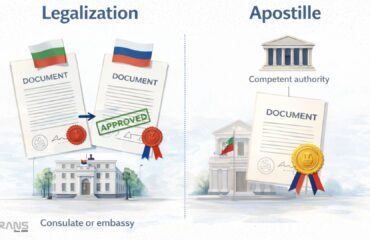
Consular legalisation, by contrast, is a far more complex and multi-stage procedure. It applies to countries that are not parties to the Hague Convention and therefore do not recognise the apostille. Under this process, the document must first be authenticated in Bulgaria – either by a notary or the relevant ministry – then legalised by the Ministry of Foreign Affairs, and finally certified by the consular section or embassy of the country where it will be used. Only after passing through all of these stages does the document acquire legal validity.
The key distinction between the two procedures lies in the scope of their international recognition. The apostille is quick, straightforward, and universally valid only among countries that are parties to the Hague Convention. Consular legalisation, on the other hand, is the “heavier artillery” – it is mandatory for countries such as the UAE, Qatar, Saudi Arabia, China, or Vietnam, where an apostille carries no legal weight whatsoever.
In practice, this means that if a Bulgarian company wishes to register a business in Germany, its documents will simply require an apostille. However, if the same company has interests in Dubai, it will need to undergo the full process of consular legalisation.
Practical guidance on choosing between an apostille and consular legalisation
The practical choice between an apostille and consular legalisation depends first and foremost on the country in which the document will be used. The most important first step is to check whether that country is a signatory to the 1961 Hague Convention. If it has signed and ratified this international treaty – as is the case with all EU member states, as well as the USA, Canada and Australia – then an apostille will be entirely sufficient, and your documents will be recognised without any further authentication.
That said, it is always advisable to verify the requirements of the specific receiving institution, since in practice some universities, banks or employers may impose their own rules which go beyond the general framework.
When dealing with countries that are not parties to the Hague Convention – such as the United Arab Emirates, Qatar, Saudi Arabia, China or Vietnam – consular legalisation is the only possible choice. This is a longer and more complex procedure, involving certification by several different authorities: first by a Bulgarian notary or the competent ministry, then by the Ministry of Foreign Affairs, and finally by the consular service of the country where the document will be used.
It is also important to factor in both time and costs. While an apostille is usually issued within a few days and involves relatively modest fees, consular legalisation can take several weeks and is often considerably more expensive, particularly when multiple administrative authorities are involved.
To avoid mistakes and unnecessary delays, it is often advisable to seek assistance from specialists – such as law firms, translation agencies, or companies offering consular services. These professionals are familiar with the finer details of the procedure, understand exactly which documents are required and how they should be prepared, and often have practical experience with the specific requirements of a given country. This not only saves time and effort but also ensures that your documents will be accepted by the foreign authorities.
Costs and Deadlines
The costs and deadlines for consular legalisation are considerably higher compared to those for an apostille, making it a more complex and burdensome procedure. Fees are charged at several stages – first by the Bulgarian authorities responsible for certifying the document, and subsequently by the consulate of the receiving state where the final legalisation takes place. Inevitably, this drives up the overall cost.
In terms of deadlines, these can range widely – from just a few days to several weeks. The length of the process depends both on the country concerned and, on the number, and type of documents requiring legalisation. While a single document may be processed relatively quickly, larger volumes or additional requirements imposed by the foreign authorities can significantly extend the overall duration.
Therefore, it is strongly advisable to plan consular legalisation well in advance. This is particularly important where documents are required for participation in international tenders, for the implementation of projects abroad, or for immigration procedures. By organising the process in good time, you can avoid unwanted delays and, more importantly, the risk of missing critical deadlines.
Consular legalisation is an essential mechanism for ensuring the recognition of documents in countries outside the Hague Convention. While the procedure may appear more time-consuming, it is absolutely necessary to safeguard the legal validity of documents abroad. A clear understanding of the process, combined with thorough preparation, can save considerable time, expense, and administrative complications.