Translation and Legalization of Banking Documents for International Use
Translation and Legalization of Banking Documents for International Use
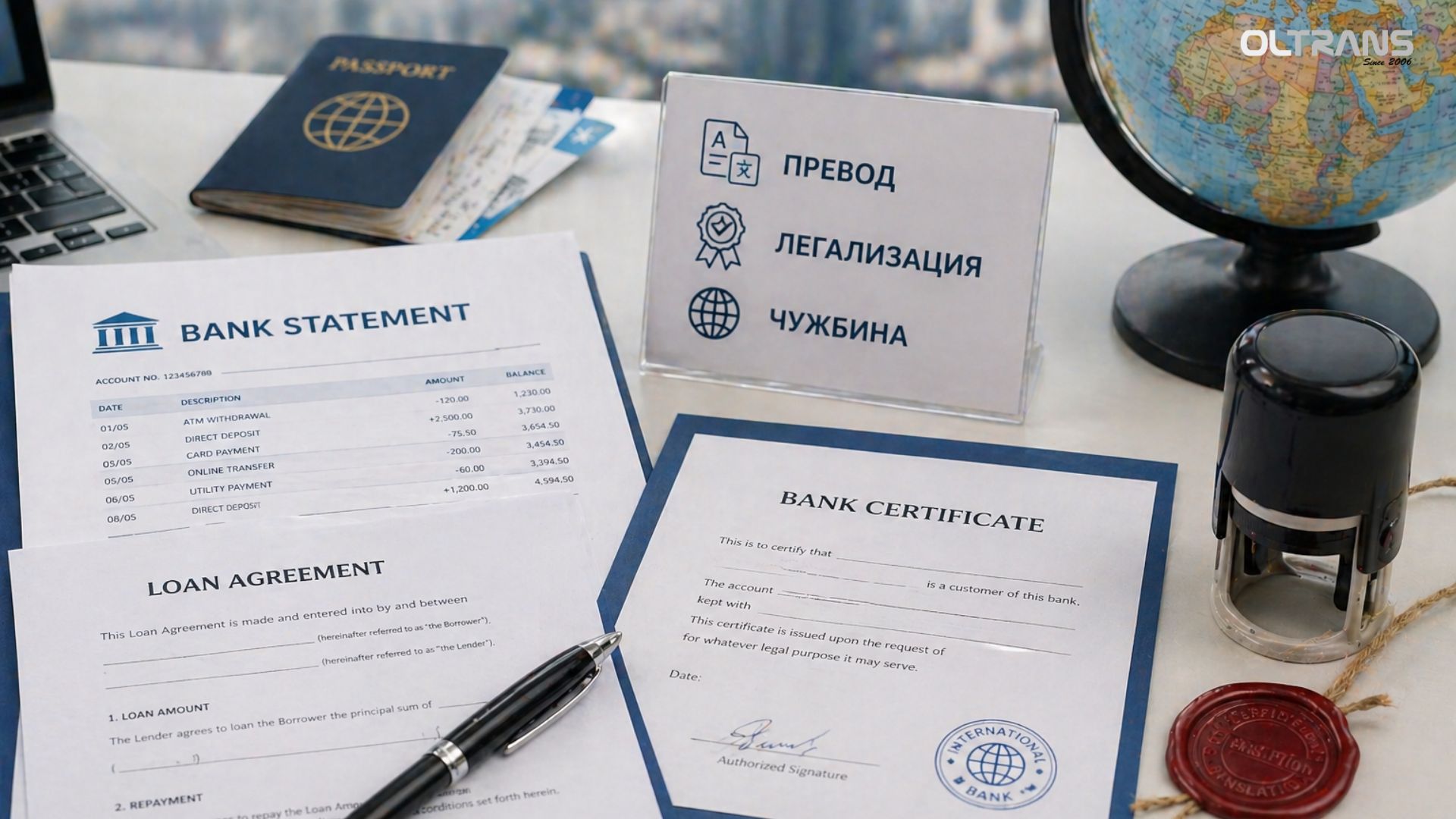
Banking documents are among the most frequently used in international transactions, employment abroad, education, or investments. They certify the financial standing of an individual or a company and are required in many situations – from opening an account in a foreign bank to proving financial solvency to a university or employer.
For them to be recognised outside Bulgaria, banking documents must go through a process of translation and legalisation. This is not merely an administrative formality – it guarantees that the document will be accepted by institutions and financial authorities abroad as authentic and valid.
Without proper translation and legalisation, even the most important document – such as a bank statement or a certificate of account balance – may be rejected, causing delays in transactions, denial of loans, or problems with university enrolment or starting a new job.
What Does the Translation and Legalisation of Banking Documents Involve?
The translation and legalisation of banking documents are processes through which documents issued in Bulgaria acquire international legal validity. They certify to foreign institutions that the document is authentic, official, and can be used for financial and administrative purposes.
Apostille as the key element
Since Bulgaria is a signatory to the 1961 Hague Convention, for most countries it is sufficient for documents to be issued with an apostille. This is a special stamp placed by the competent Bulgarian authorities that certifies the authenticity of the signature, seal, or content. Without an apostille, banking documents will not be recognised abroad.
Official translation by a sworn translator
Once the apostille is applied, all banking documents must be translated into the language of the country where they will be used – for example, English, German, Spanish, or French. The translation must be performed by a sworn translator to carry legal weight. Unofficial translations or automated translation tools are not accepted by foreign institutions.
Notarial certification if required
In some cases, particularly when copies of documents are used (such as a copy of a bank statement or a solvency certificate), notarial certification may be required. The notary verifies that the copy corresponds to the original. This is an additional step and does not replace the apostille.
Which Banking Documents Require Translation and Legalisation?
Not all banking documents need to be translated and legalised, but in international financial operations there are certain categories that are almost always required by foreign institutions.
Bank account statements
These are the most commonly requested documents when opening an account abroad, proving income, or applying for a visa. They certify account balances and transaction history.
Certificates of solvency and income
Banks often issue certificates confirming financial standing or regular income, which are used for loans, mortgages, or investments abroad.
Loan and credit documents
Bank loan agreements, mortgage contracts, or certificates of loan repayment are required when transferring obligations or applying for new credit in another country.
Confirmations of international transfers
For larger financial transactions, official confirmations from the bank regarding executed payments are frequently requested.
Certificates of account opening and bank references
These documents are often required in business partnerships, investments, or when working with Western institutions that demand proof of stability and reliability.
Step-by-Step Procedure for Translation and Legalisation
For banking documents to have legal validity abroad, they must go through a clearly defined sequence of actions. Even skipping one step may result in rejection by foreign institutions or banks.
- Obtaining original documents
You must first secure official statements, certificates, or contracts issued by the bank. These must bear an authorised signature and stamp. - Notarial certification (if required)
When submitting a copy of a banking document instead of the original, a notary must certify that the copy matches the original. - Applying the apostille
Depending on the type of document, the apostille is issued by the competent Bulgarian authorities:
- Ministry of Justice – for notarised documents;
- Ministry of Foreign Affairs – for administrative certificates.
In countries that are members of the Hague Convention, the apostille is sufficient. For other countries, consular legalisation will be required.
- Official translation
All banking documents must be translated into the language of the country where they will be used. The translation must be carried out by a sworn translator. - Certification of the translation (if required)
Some countries require the translator’s signature to be notarised. This serves as an additional guarantee of authenticity. - Verification of the complete set
Foreign banks and institutions often request more than one document – for example, a bank statement accompanied by a certificate of solvency.
Differences Between Procedures in the EU and Outside the EU
The procedures for translating and legalising banking documents depend entirely on whether they will be used in a European Union member state or outside the EU.
Within the European Union
Bulgaria and the other member states apply Regulation (EU) 2016/1191, which significantly simplifies the movement of official documents. This means:
- For some banking certificates, an apostille is no longer required – an official translation is sufficient;
- Certain documents can be issued in a multilingual format (for example, a certificate of address or financial status), which allows their direct use across the EU;
- The main requirement remains that documents must be translated by a sworn translator into the language of the host country.
In non-EU countries
Here, the rules are more complex and depend on international agreements:
- If the country is a party to the 1961 Hague Convention (such as the USA, Canada, Australia, or Japan), banking documents must be provided with an apostille and an official translation;
- If the country is not a member of the Convention (for example, Kuwait, the UAE, or Qatar), full consular legalisation will be required. This involves certification at Bulgaria’s Ministry of Foreign Affairs and further legalisation at the embassy of the respective country;
- In rare cases, bilateral agreements apply, which simplify the process – for example, recognition with just a translation, without an apostille.
Technology and Digitalisation in the Legalisation of Banking Documents
In recent years, both the banking sector and the institutions responsible for document legalisation have increasingly embraced digitalisation. This has made it significantly easier for Bulgarian citizens and companies using financial documents abroad.
Electronic apostille (e-Apostille)
Within the framework of the Hague Convention, a system for electronic apostille is being developed – a digital stamp that can be applied to electronic documents. It can be verified online by foreign authorities, eliminating the need for paper certifications and long waiting times.
Online verification of documents
Many banks and institutions in the EU now provide electronic registers for verifying the validity of documents. This allows a foreign institution to check remotely whether a banking certificate or statement is authentic.
Digitalisation in Bulgaria
In Bulgaria, the process is still developing, but electronic services for issuing banking certificates, statements, and official documents are gradually being introduced. In the coming years, a significant part of translations and legalisations is expected to be carried out entirely online – saving time, costs, and bureaucracy.
Common Mistakes and How to Avoid Them
The process of translating and legalising banking documents may seem straightforward, but in practice mistakes are often made. These can lead to serious consequences – delays, rejection by foreign institutions, or even blocked financial transactions.
Missing apostille
One of the most common errors is submitting documents with only a notarial certification or a translation, but without an apostille. In most countries outside the EU, an apostille is mandatory, and without it the documents are considered invalid.
Inaccurate or incomplete translation
Using freelance translators or online tools often results in errors in terminology – particularly with complex banking terms. Foreign institutions accept only sworn translations, and even minor inaccuracies can render the entire document invalid.
Incomplete set of documents
It is common to submit only a bank statement, while omitting supporting documents such as account holder certificates, declarations, or confirmations from the bank. This can lead to outright rejection.
Late preparation
Obtaining an apostille, arranging an official translation, and completing a notarial certification all take time. If you start the process at the last minute, you risk missing important deadlines for transactions, loan applications, or proof of funds abroad.
How to avoid these mistakes?
- Check the specific requirements of the country and institution where the documents will be submitted.
- Use a sworn translator and experienced legalisation specialists.
- Prepare a checklist and begin the process at least a month in advance.
Frequently Asked Questions (FAQ)
- Do all banking documents need to be legalised?
No. Legalisation is only required if the documents will be presented to foreign institutions – such as banks, courts, tax authorities, or immigration offices. - How long does the translation and legalisation process take?
Usually a few days (for translation and apostille) to several weeks (if consular legalisation is needed for non-EU countries). - Are translations by freelance translators accepted?
No. To have legal value, translations must be carried out by a sworn translator. - Can the same set of documents be used in more than one country?
Yes, if the documents are apostilled and translated into the relevant language. However, some countries may require originals rather than copies, so it is important to check in advance. - Is notarial certification required if I already have an apostille?
Only if you are submitting copies of documents. A notary certifies that the copy is identical to the original.
Statistics and Trends
In today’s globalised world, banking documents cross borders more frequently than ever. Bulgarian citizens and companies are active participants in this process – whether it’s opening accounts, taking out loans, investing, or managing inheritance cases abroad.
Bulgarians with bank accounts abroad
According to the European Central Bank and national studies, tens of thousands of Bulgarian citizens maintain bank accounts in countries such as Germany, Spain, the United Kingdom, and Austria. Migration and employment abroad have created a growing demand for international banking services.
Increasing need for legalisation
Every year, thousands of banking documents – statements, account certificates, income or loan confirmations – go through translation and legalisation. This trend is especially visible in immigration procedures, loan applications, and business transactions.
Digitalisation
More and more banks and institutions are adopting electronic documents. This shift has also led to the introduction of e-Apostille systems, which speed up the process and reduce bureaucracy.
Interesting Facts and Insights
- Bank accounts and inheritance – In many countries, including France and Italy, access to the account of a deceased person is only possible once legalised documents are presented – such as a death certificate, heirship certificate, and bank statements. Without translation and apostille, banks block access to funds until a complete set of documents is provided.
- Different rules in different countries – In Germany, an English or German translation is often sufficient, while in Austria an official sworn translation into German is mandatory. In the United States, requirements vary by state, often surprising clients who expect uniform rules.
- Banking documents for visas and immigration – Many countries, such as Canada, Australia, and the United Kingdom, require proof of income or funds in the form of legalised bank statements when applying for a visa. This makes translation and legalisation a key part of the immigration process.
- Historical note – Until Bulgaria joined the Hague Convention in 2001, legalising banking documents was extremely cumbersome. Full consular certification was required for each country, often taking months to complete.
The translation and legalisation of banking documents for use abroad are unavoidable steps for anyone dealing with international financial operations – from opening an account and securing a loan to proving income or managing inheritance. Without properly prepared documents, there is a real risk of delays, rejection, or even blocked access to funds.
Thanks to the Hague Convention, the procedure is simpler for member states, but outside the Convention full consular legalisation is often required. In all cases, sworn translation remains mandatory to ensure documents are accepted by foreign institutions.
This is where Oltrans comes in – a company with extensive experience in translating and legalising banking and financial documents. Our team offers:
- sworn translations into the main European and global languages;
- full organisation of the process – from apostille to final certification;
- assistance with tight deadlines and specific requirements of banks and administrative bodies.
Trust Oltrans to guide you through the entire process securely, quickly, and without unnecessary stress – so you can focus on what truly matters: managing your finances and successfully carrying out your international plans.