The Difference Between Apostille and Legalisation
The Difference Between Apostille and Legalisation
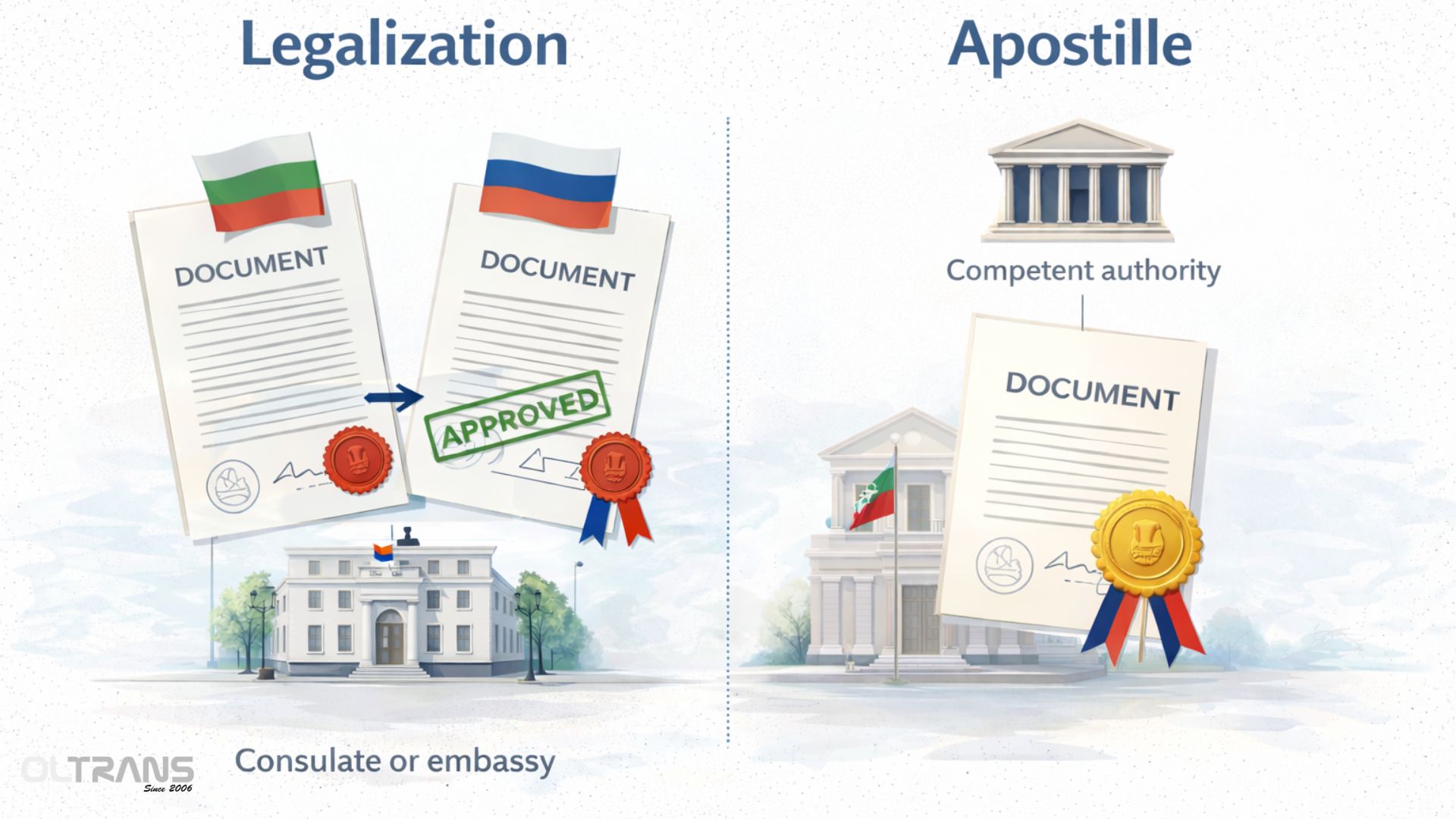
When documents need to be used abroad, it is often required that they be legalised in order to be recognised by foreign authorities. The two primary methods of legalising documents are apostille and consular legalisation. While both procedures aim to authenticate the documents, they have different processes, requirements, and applications.
This article will explore in detail what apostille and consular legalisation are, when each is used, and which documents require one or the other procedure.
What is an Apostille?
An apostille is a certificate that authenticates a document for international use, making it valid in countries that are signatories of the Hague Convention of 1961. The procedure for obtaining an apostille is much simpler and quicker than consular legalisation, as it does not require verification from consulates or embassies. An apostille is necessary when:
- The document is to be used in a Hague Convention country.
- The document is an original or certified copy of the original.
- The document is issued by an official authority (e.g., courts, universities, health institutions).
How is an Apostille Applied?
An apostille is issued by an official body authorised to apply it. In the UK, this would typically be the Foreign, Commonwealth & Development Office (FCDO) or a notary public. Once the apostille is applied, the document becomes valid for use in other countries that are part of the Hague Convention without requiring additional verification from foreign consular authorities.
What Documents are Eligible for an Apostille?
- Personal documents (birth certificates, marriage certificates, death certificates).
- Educational documents (diplomas, academic transcripts).
- Notarised documents (powers of attorney, contracts, declarations).
- Court decisions and other documents issued by public authorities.
What is Consular Legalisation?
Consular legalisation is a more complex process in which documents must be verified by diplomatic or consular representatives of the country where the document will be used. This procedure is required when the country where the document will be used is not a signatory of the Hague Convention, or when the documents cannot be apostilled.
Consular legalisation involves two main steps:
-Initial verification from local authorities in the country of origin (e.g., local offices or ministries that issue the original document).
-Verification by the consulate or embassy of the country where the document will be used. This step authenticates that the document is valid and conforms to the requirements of the relevant country.
When is Consular Legalisation Required?
Consular legalisation is necessary when: The document is intended for use in a non-Hague Convention country. the document cannot be apostilled (e.g., documents issued by diplomatic missions or certain private entities).
Examples of Documents Requiring Consular Legalisation:
- Documents for immigration and work in non-Hague Convention countries (e.g., Saudi Arabia, China, UAE).
- Business and commercial documents (e.g., trade contracts, company registration papers) for use in non-Hague Convention countries.
- Marriage certificates when marrying a foreign national in a non-Hague Convention country.
- Court and legal documents that need to be recognised by foreign courts or authorities in non-Hague Convention countries.
Main Differences Between Apostille and Legalisation
| Criterion | Apostille | Legalisation |
| How is it applied? | Issued by an official government authority (e.g., FCDO, notary). | Verified by diplomatic or consular representatives (embassies or consulates). |
| Document Requirements | Document must be issued by an official authority (e.g., court, university). | Requires additional verifications from local authorities and consular officials. |
| Speed | Faster (usually 3–5 working days) | Slower (can take up to 10-15 working days or more). |
| Cost | Less expensive (due to fewer steps). | More expensive (due to additional steps and consular fees). |
| Where is it used? | For documents to be used in Hague Convention countries. | For documents to be used in non-Hague Convention countries. |
When is Apostille and When is Legalisation Used?
Apostille and consular legalisation are two different procedures used to authenticate documents for use abroad. The main difference between them depends primarily on the country where the document will be used, as well as the procedure for its legalisation.
1. Apostille
Examples of situations when an apostille is required:
- Studying abroad: If you have a diploma or academic transcript from a Bulgarian university and want to continue your studies in a country that is a signatory of the Hague Convention, your document must be apostilled. This way, it will be recognised by foreign educational institutions.
- Working abroad: If you are working or applying for a job in a country that is a member of the convention, you need to legalise your diplomas or criminal records with an apostille in order for them to be recognised by employers or government authorities.
- Marriage to a foreign national: If you are getting married to a foreign citizen in a country that is a part of the Hague Convention, your marriage certificate can be apostilled to be recognised by the foreign authorities.
- Court documents: In the case of court decisions or powers of attorney that need to be recognised by foreign courts or legal institutions, an apostille is necessary if the destination country is a signatory of the Hague Convention.
When is the Apostille Used?
When the document will be used in a country that is a member of the Hague Convention.
When the document is issued by an official authority, such as a court, university, or government institution. The procedure is quick and does not require additional verification by consular services.
Countries That Require an Apostille: Countries that are members of the Hague Convention (most European countries, the USA, Canada, Australia, Japan, South Korea, India, South America, and others).
2. Consular Legalisation
Examples of situations where consular legalisation is used:
- Documents for immigration and work in non-Hague Convention countries: For instance, if you are applying for a job or visa in a country like the United Arab Emirates or Saudi Arabia, which are not signatories of the Hague Convention, your documents will need to go through the process of consular legalisation in order to be recognised by the local authorities.
- Business and commercial documents: When doing business with a country outside the Hague Convention and you need to present business contracts, company registration documents, or other legal papers, these may need to be legalised through consular verification.
- Marriage to a citizen of a non-Hague Convention country: If you are marrying a citizen from a country that is not part of the Hague Convention, such as Iran, Iraq, or Malaysia, you will need to go through the consular legalisation process for your marriage certificate.
- Documents for court and administrative procedures: If you need to submit court documents or powers of attorney in countries outside the Hague Convention, these documents will need to go through consular legalisation.
When is Consular Legalisation Used?
- When the document will be used in a country that is not part of the Hague Convention.
- When the document cannot be apostilled (for example, documents issued by embassies, documents that require additional verification).
- The procedure is slower and more complex, as it involves verification from several different bodies, including consular checks.
- Countries That Are Not Part of the Hague Convention and Require Consular Legalisation: Iran, Iraq, Saudi Arabia, China, United Arab Emirates, Qatar, South Korea (depending on specific cases), India, and others.
How to Choose Which Procedure to Use?
The choice between apostille and consular legalisation depends on several important factors. Making the correct choice will save you time and money and ensure that your documents are recognised by foreign institutions. Here’s how to choose the appropriate procedure:
1. Check if the country where the document will be used is part of the Hague Convention.
- If the country is a member of the Hague Convention, it will be sufficient to obtain an apostille.
- If the country is not a member of the Hague Convention, you will need to go through consular legalisation.
2. Document Type
- Certain documents require specific procedures, regardless of the country where they will be used. For example, documents such as powers of attorney, court decisions, or notarised acts generally cannot be apostilled and must go through consular legalisation.
3. Urgency of the Process
Obtaining an apostille is generally faster and simpler than consular legalisation. The apostille process can usually be completed in 3-5 working days, whereas consular legalisation might take longer due to additional steps like consular checks and verification from local authorities. It may take up to 2-3 weeks in some cases.
4. Cost of the Procedure
Apostille is usually cheaper, as the process is more straightforward and requires fewer steps. In the UK, for example, the cost of obtaining an apostille is relatively low, typically ranging from £10 to £30 per document.
On the other hand, consular legalisation is typically more expensive, due to the need for additional steps such as consular verification and consular fees. The costs can range from £50 to £200, depending on the country and the type of document.
5. Document Translations
Some countries require documents to be officially translated into their local language, and this may also need to be legalised or apostilled. It is important to ensure that translations are done by an official translator and that they meet the legal requirements of the destination country. Apostille does not require additional verification for translations, but official translations might be needed. Consular legalisation may include additional checks for translations, so it’s important to confirm whether translation verification is needed as part of the process.
Choosing between apostille and consular legalisation depends on several factors, including the country where the document will be used, the type of document, time constraints, and costs. By understanding when to use each procedure, you can ensure your documents are properly legalised and will be accepted by foreign authorities.
If you need help with apostilling or legalising documents, don’t hesitate to contact us for professional assistance and express processing!