Translation and Legalization of Pension Documents from Abroad
Translation and Legalization of Pension Documents from Abroad

An increasing number of Bulgarian citizens are working and living abroad, and as a result more and more people become entitled to claim pensions from foreign countries. Whether the employment history comes from an EU Member State, a country with a bilateral agreement, or from outside these frameworks, the payment of a pension always requires the submission of official documents to the Bulgarian authorities.
This is where translation and legalisation play a crucial role. They ensure that documents issued abroad are officially recognised in Bulgaria and carry legal weight. Without them, the National Social Security Institute (NSSI), the courts or other competent bodies cannot process or accept the documents concerned.
Many people underestimate these steps, which often leads to delays, extra costs or even refusal by the authorities to accept the paperwork. When it comes to pensions – the main source of income and security for many people or their heirs – any delay can cause serious inconvenience.
What pension documents are required from abroad?
Whenever a Bulgarian citizen has worked abroad and is entitled to a pension, certain documents must be presented so that this employment record can be officially recognised in Bulgaria. These documents prove periods of insurance, income and pension rights acquired abroad.
The most common ones include: a certificate of employment and income issued by the foreign social security institution; the pension award decision, which specifies the type and amount of pension; certificates of accrued pension rights; extracts from the social security system confirming contribution history; and, where applicable, certificates of heirs if relatives apply for survivor’s benefits. In some countries, additional evidence such as employment contracts, employer confirmations or statements from private pension funds may also be required.
It is important to note that the type and content of documents vary depending on the issuing country. Within the European Union, standardised forms (such as the E and U series) are frequently used to facilitate the exchange of information between institutions. Outside the EU, however, documents are usually issued individually and must undergo strict procedures of legalisation and translation.
Before submitting anything to Bulgarian authorities, it is highly advisable to check with the competent foreign institution or seek professional advice to ensure that you obtain the correct set of documents.
Why are translation and legalisation necessary?
Official translation is essential for the recognition of pension documents issued abroad. These documents often contain highly specific terminology relating to social security and pension law. Even a minor mistranslation can result in misinterpretation or rejection of the documents. For this reason, the NSSI and other authorities will only accept translations carried out by sworn translators or translation agencies authorised by the Bulgarian Ministry of Foreign Affairs.
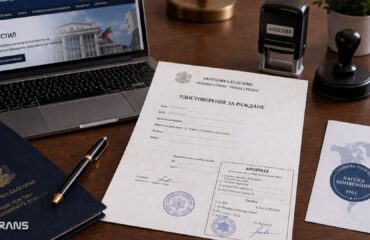
Alongside translation, legalisation is also required. This is the process of authenticating a document so that it is valid in another country. Depending on the country of origin, this may be done by affixing an Apostille (for states party to the Hague Convention of 1961) or through full consular legalisation (for countries outside the Convention). Only after this step is completed can the document be officially used in Bulgaria.
It is equally important to distinguish between an ordinary translation and an officially certified one. An ordinary translation, done by anyone, has no legal force. An official translation, however, is carried out by a sworn translator registered with the Ministry of Foreign Affairs or by a licensed agency, and is duly stamped or certified so that it can be formally recognised.
The legalisation procedure
Legalisation is the process by which a document issued in one country is recognised as valid in another. For pension documents from abroad, this is mandatory. In countries that are parties to the Hague Apostille Convention, the process involves affixing an Apostille – a specific seal or sticker confirming authenticity. Where the country is not a party to the Convention, consular legalisation is required. This means that the document must first be authenticated by the Ministry of Foreign Affairs of the issuing country, and then legalised at the Bulgarian embassy or consulate there.
Several institutions are usually involved: the foreign Ministry of Foreign Affairs, the relevant Bulgarian diplomatic mission, and finally the Bulgarian Ministry of Foreign Affairs, which confirms the legalisation already applied. Typically, the steps are as follows: issue of the document by the competent authority; affixing of Apostille or consular certification; verification at the Bulgarian MFA; translation by a sworn translator; and certification of the translation so that it can be used officially.
Within the European Union, the process is considerably easier thanks to standardised forms and mutual recognition. Outside the EU and the Hague Convention, however, legalisation tends to be longer, more complex and more costly, as it requires more stages and endorsements.
Which Bulgarian institutions require translation and legalisation?
The National Social Security Institute (NSSI) is the main body responsible for processing applications for pensions in Bulgaria. It requires that all foreign employment and pension documents be officially translated and legalised. In the case of EU pensions, the NSSI also exchanges information through standard administrative forms, but additional paperwork is often requested from the claimant.
Bulgarian courts also require certified translations and legalisations in cases concerning recognition of employment periods, inheritance rights or disputes about pension payments. Without proper authentication, such evidence can be rejected.
Notaries may also require pension-related documents from abroad when certifying declarations, powers of attorney or inheritance rights, and will only accept documents accompanied by certified translations.
Other public authorities – such as the Ministry of Finance, tax offices, municipalities or social services – may also ask for such documentation in order to verify income from a foreign pension when granting benefits or calculating tax obligations.
As each authority may have slightly different requirements, it is advisable to contact them in advance before beginning the legalisation and translation process.
Common problems and how to avoid them
In practice, many difficulties may arise. Sometimes documents are incomplete or issued incorrectly, for example without specifying precise employment dates. Others may lack an Apostille or consular certification, which renders them invalid in Bulgaria. Poor-quality translations can also cause rejections, while the entire process may be delayed if foreign institutions take a long time to issue the paperwork.
To avoid these problems, always check that the document contains all required details before having it legalised and translated. Confirm whether the issuing country is a party to the Hague Convention and, if not, what its procedures for consular legalisation are. Work only with sworn translators or agencies authorised by the Bulgarian MFA. Start preparing well in advance – ideally several months before applying for a pension – and keep copies of everything. This way you will minimise costs, delays and the risk of rejection.
Practical tips
The process becomes much easier if you approach it systematically. Always check your documents at source, ensuring that they are complete and properly signed and stamped. Confirm whether an Apostille is required and whether the country of origin is part of the Hague Convention. Choose a reliable translation agency with proven experience in pension and legal documents, and insist on official stamps and certification.
Before submitting to the NSSI, make sure you have the full package: the original document, Apostille or consular certification if necessary, a certified translation by a sworn translator, the agency’s stamp, and verification of validity periods where applicable. Keep copies of everything, as institutions sometimes require the same paperwork more than once. Above all, do not leave it until the last moment – preparation started a few months in advance will save time, money and unnecessary stress.
The translation and legalisation of pension documents from abroad are essential steps to ensure that your paperwork is recognised and accepted by the Bulgarian authorities. Without properly prepared documents – certificates of employment, pension award decisions, or extracts from social security systems – the process can be delayed or even blocked.
Procedures within the European Union are much simpler thanks to harmonised regulations and standard forms, while outside the EU an Apostille or full consular legalisation is often required. Early preparation is therefore a key factor for success.
The most common mistakes – missing Apostilles, inaccurate translations or incomplete document sets – can easily lead to refusal by the authorities. To avoid such issues, it is best to work with professionals who understand the details of the process.
This is where Oltrans comes in – a company with long-standing experience in the translation and legalisation of official documents. Our team provides sworn translations in multiple languages, tailored to the requirements of different countries, complete organisation of the entire process from Apostille to final certification, and reliable assistance even under tight deadlines or specific requirements.
If you are about to arrange your pension from abroad and want your documents to be accepted without difficulty, trust Oltrans. With our help, you can go through the procedure quickly, securely and without unnecessary stress – so that you can focus on what matters most: enjoying the peace of mind and security of your well-earned pension.