Do Official Translations Get Recognized Between Countries?
Do Official Translations Get Recognized Between Countries?

In today’s globalized world, communication and the exchange of information between different countries are a daily part of both business and personal matters. Whether it’s for legal proceedings, academic purposes, or business transactions, accurate and certified translations play a pivotal role in ensuring smooth interactions across borders. However, an important question arises: Do official translations get recognized between countries?
Official translations are necessary when documents issued in one country need to be used in another. But for these translations to be valid and accepted, they often need to undergo specific procedures to ensure their authenticity. These processes may include legalization or apostille, and the recognition of these translations varies depending on the countries involved.
What is an Official Translation?
An official translation is a translation of a document that has been carried out by a certified translator or translation agency. These translations are usually accompanied by the translator’s certification or a statement affirming that the translation is accurate and faithful to the original document. In many cases, this certification must also be notarized to confirm its authenticity.
Official translations are crucial for the proper legal recognition of documents such as diplomas, birth certificates, contracts, court decisions, and other essential documents. These translations are used in a variety of settings, including legal proceedings, business deals, and immigration or academic applications.
How are Official Translations Recognized Between Countries?
International Agreements and Conventions
The recognition of official translations between countries is not universal. Different countries may have varying procedures and requirements for validating foreign documents, and these can be influenced by international agreements and conventions.
One of the most important international agreements in this regard is the Hague Convention of 1961, which eliminates the need for diplomatic or consular legalization of foreign public documents between member states. Instead, it establishes a simplified process through the use of an apostille, which is a form of certification recognized internationally. Countries that are members of this convention generally accept documents from each other with an apostille, making the process much easier and quicker than traditional legalization.
Apostille vs. Legalization
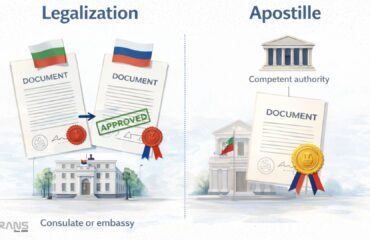
While apostille is generally a quicker and simpler method, legalization still plays an important role, especially for countries that have not signed the Hague Convention. Legalization is a process in which a foreign public document is verified and authenticated by a government body, such as an embassy or consulate, in the country where the document is to be used. This process can be time-consuming and more complex than the apostille procedure.
Apostille: This is a certification placed on a document to confirm its authenticity. It is a faster and easier process, valid only between countries that are parties to the Hague Convention.
Legalization: This is a longer and more complex procedure used for countries that are not parties to the Hague Convention. It involves verification and certification by consular or diplomatic authorities.
Visual table
| Process | Description | Requirements | Countries Where Used |
| Legalization | A procedure for certifying documents, which involves verification by diplomatic or consular authorities in the country where the document will be used. | The document must be verified by diplomatic or consular authorities, and the process may take more time. | Countries that are not signatories of the Hague Convention. |
| Apostille | A faster and simplified procedure for certifying documents, valid only between countries that have signed the Hague Convention. | Only requires the addition of an apostille to the document by the authorized institution in the country of origin. | Countries that have signed the Hague Convention of 1961. |
What Steps Might Be Required for International Recognition of Official Translations?
Legalization and Apostille
Even if a document is translated by a certified translator, it may still need further verification for international use. This is where legalization or apostille comes into play. Depending on the country where the document will be submitted, one of these processes may be required to ensure the document’s authenticity.
- Legalization is used when the destination country is not a part of the Hague Convention. In this case, the document will be authenticated through the diplomatic channels of the country where it is to be used, often by a consulate or embassy.
- Apostille is a simpler process that is used between countries that are signatories of the Hague Convention. This process involves the addition of a special certification (the apostille) to the document, which certifies that it is a true and original copy of the document.
When is Apostille Needed, and What Does It Entail?
An apostille is a form of international certification used to authenticate documents for use in countries that are signatories to the Hague Convention of 1961. The apostille verifies that the document is genuine and is recognized by other member states of the convention. It eliminates the need for additional legalization through consulates or embassies, making the process quicker and more efficient.
When is Apostille Needed?
An apostille is typically required when a document, including an official translation, needs to be used in a foreign country that is a member of the Hague Convention. If the document is being submitted to a country that recognizes the apostille process, this additional certification is required to verify its authenticity. Here are common scenarios where an apostille is needed:
- Academic and Educational Documents: If you are submitting your diploma, transcripts, or other academic credentials to be recognized in a foreign country for educational or professional purposes, an apostille may be necessary. For example, if you want to study abroad or work in another country, your academic documents may need to be apostilled.
- Legal Documents: When submitting legal documents such as a power of attorney, divorce decree, or birth certificate for use in another country, an apostille can be used to certify the document’s authenticity.
- Business and Commercial Documents: Documents related to business activities, such as contracts, certificates of incorporation, or financial statements, may require an apostille when being used in international transactions or dealings.
- Personal Documents: Personal documents, such as marriage certificates, death certificates, and adoption records, may require an apostille for use in legal or administrative procedures in another country.
What Does the Apostille Entail?
An apostille is essentially a certificate that confirms the authenticity of a public document. It verifies the legitimacy of the signature, seal, or stamp on the document and ensures that it is legally valid in other countries that are members of the Hague Convention. Here’s what the apostille process entails:
Verification of Document: To obtain an apostille, the document must first be verified by a competent authority in the country where it was issued. This authority could be a government agency, such as a court, notary public, or an office that handles public records.
Issuance of Apostille Certificate: Once the document has been verified, the apostille certificate is attached to the document. The apostille includes the following information:
- The country where the document was issued
- The name of the person who signed the document
- The capacity in which the person signed the document
- The seal or stamp of the relevant authority
- The date and place where the apostille was issued
- The name of the issuing authority and the official seal
- Recognition in Foreign Countries: The apostille allows the document to be accepted by authorities in other Hague Convention countries without the need for further authentication or embassy verification.
Countries Where Apostille is Used The apostille process is valid only between countries that are parties to the Hague Convention of 1961. As of now, more than 120 countries are signatories to the convention, making the apostille an internationally recognized form of certification.
These countries agree to accept apostilled documents from other member states, making it easier to use documents abroad.
Some examples of countries that recognize the apostille process include:
- United States
- United Kingdom
- Canada
- France
- Germany
- Japan
- Australia
- Spain
- Italy
- South Africa
However, it’s important to note that countries that are not signatories of the Hague Convention require the traditional legalization process, which involves verifying documents through consular or diplomatic channels.
Key Differences Between Apostille and Legalization
While apostille simplifies the authentication process for documents being used in Hague Convention countries, the legalization process is still needed for non-member countries. Legalization involves additional steps, such as visiting a consulate or embassy of the country where the document will be used, and it can be a lengthier procedure.
An apostille provides the same level of authenticity as legalization but in a more streamlined manner. It’s a single certificate that can be affixed to a document, making it much more convenient for international use in countries that are part of the Hague Convention.
Visual table
| Aspect | Apostille | Legalization |
| Purpose | Simplified process of certifying documents for use in Hague Convention countries. | Certification process for documents to be used in non-Hague Convention countries. |
| Applicable Countries | Valid only between countries that are signatories of the Hague Convention (over 120 countries). | Used for countries that are not signatories of the Hague Convention. |
| Process | A single certificate attached to the document, verifying its authenticity. | Involves multiple steps, including verification by consular or diplomatic authorities. |
| Time Frame | Faster and more streamlined process, usually taking a few days. | Can be a longer process due to the involvement of embassies or consulates. |
| Authority Involved | Issued by designated authorities such as notaries, courts, or other governmental bodies in the country where the document originated. | Issued by consular or diplomatic authorities, requiring a more complex procedure. |
| Document Requirements | Only one step of authentication is required, the apostille. | Requires multiple layers of authentication before final approval. |
| Cost | Typically lower due to the simplified procedure. | Generally more expensive due to the involvement of diplomatic or consular offices. |
| Use | Used for public documents like birth certificates, academic diplomas, contracts, etc., between member countries. | Used for documents to be recognized in countries outside the Hague Convention. |
Recognition by Different Institutions
The recognition of official translations may also depend on the type of institution or organization to which they are being submitted. In many cases, these institutions will have their own specific rules regarding translation certification, which may involve additional steps like apostille or legalization.
Legal Institutions
When presenting documents in legal contexts, such as court proceedings or contracts, translations need to be certified by an accredited translator. In some cases, additional procedures such as legalization or apostille may be required, especially if the documents come from a country that is not part of the Hague Convention.
Administrative and Educational Purposes
For immigration processes, university applications, or other administrative purposes, official translations are frequently required. For example, if you are applying for a visa, citizenship, or work permit, you may need to submit translated documents such as birth certificates, marriage certificates, or academic diplomas. These documents must be translated by a certified translator, and some countries may require that these translations also be apostilled or legalised to ensure they are valid.
Business and Commercial Documents
In the business world, official translations are often necessary when entering into contracts, agreements, or negotiations with international partners. These translations must be accurate and may need to go through the apostille or legalisation process to ensure that they are legally binding and recognised by foreign governments.
The recognition of official translations between countries is crucial for international communication and transactions. However, it is not a simple process and often requires additional steps, such as legalization or apostille, depending on the countries involved. To ensure that your documents are recognized and legally valid abroad, it is essential to follow the correct procedures, whether that involves getting translations certified by accredited translators, applying for an apostille, or going through diplomatic channels for legalization.
By understanding these processes, you can avoid delays and ensure that your official documents are accepted internationally, whether for legal, administrative, educational, or business purposes. Always make sure to check the specific requirements for the country where your documents will be used to ensure compliance with local laws and regulations.
This article provides a thorough overview of the steps required for the recognition of official translations between countries, emphasizing the importance of understanding these procedures for seamless international interactions.
Contact us via:
- Email address:
- Phone
- The chatbot on our website