Document Translation Requirements for Immigration Purposes
Document Translation Requirements for Immigration Purposes

When U.S. citizens or companies plan to use their documents abroad, one of the biggest hurdles they face is ensuring that these documents are recognized as valid by foreign governments. A diploma issued in New York, a power of attorney notarized in California, or a birth certificate from Texas will not automatically be accepted overseas. To be recognized, these documents must go through document legalisation — a process that verifies their authenticity.
For countries within the European Union, the process is often simplified through international agreements. However, for non-EU countries, and especially those that are not part of the Hague Apostille Convention, the requirements can be much stricter and more complicated.
This article will provide a detailed overview of how U.S. documents can be legalized for use in non-EU countries. It will break down the process step by step, discuss the Hague Apostille Convention, examine specific country requirements, and provide practical tips for avoiding common pitfalls.
What is Document Legalisation and Why is it Important?
Document legalisation is the process of authenticating or certifying a document so that it will be recognized in another country. Legalization ensures that a U.S.-issued document, whether personal or business-related, can be accepted as valid by foreign authorities.
Without legalization, even genuine documents may be rejected abroad.
For example:
- A U.S. student applying to a Chinese university will not be able to use their American diploma unless it is legalized.
- A company exporting goods to the UAE may have its commercial invoices rejected if they have not been legalized by the UAE embassy.
- A family moving to Russia might need to legalize birth and marriage certificates before they can be registered.
Legalisation is essentially a chain of trust: each step in the process verifies the authenticity of the signatures, seals, and issuing authority on the document, until the destination country’s consulate or embassy affirms its validity.
The Role of the Hague Apostille Convention
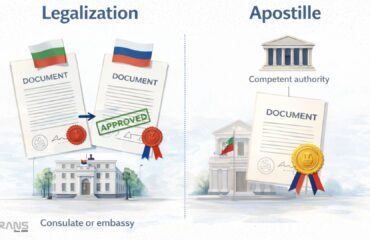
The Hague Apostille Convention of 1961 was established to simplify the legalization process between member countries. Instead of going through multiple rounds of authentication and consular certification, documents can simply receive an apostille — a standardized certificate that confirms their authenticity.
U.S. and Apostille: The United States is a member of the Hague Convention, which means that U.S. documents only need an apostille if they are to be used in another Hague Convention country.
Non-Hague Countries: If the destination country is not part of the convention, an apostille alone is not enough. In such cases, documents require full consular legalisation, which is more complex and time-consuming.
For example:
- A U.S. diploma intended for France (a Hague member) requires only an apostille.
- The same diploma intended for China (not a Hague member) must go through U.S. authentication, U.S. Department of State verification, and legalization at the Chinese embassy.
Steps for Legalising U.S. Documents Outside the EU
The process of legalizing U.S. documents can be broken down into several stages. The exact steps depend on the destination country and whether it is a member of the Hague Convention.
- Notarization and Local Authentication
For documents such as affidavits, contracts, or powers of attorney, the first step is notarization by a U.S. notary public. This confirms the authenticity of the signature on the document. Some documents, like birth or marriage certificates, do not need notarization but may require a certified copy from the issuing authority.
- State-Level Authentication
Once notarized or certified, the document must often be authenticated by the Secretary of State in the state where it was issued. Each state has its own authentication office, and they provide either:
An apostille (if the destination country is a Hague member).
A certification (if the destination country is not a Hague member).
- Federal-Level Authentication (U.S. Department of State)
For documents intended for non-Hague countries, after state-level certification, the next step is authentication by the U.S. Department of State in Washington, D.C. This step verifies the signature of the state official who authenticated the document.
- Apostille for Hague Countries
If the destination country is part of the Hague Convention, a state-level apostille is sufficient, and the process ends here. No consular involvement is necessary.
- Consular Legalization for Non-Hague Countries
For non-Hague countries, the final step is legalization by the embassy or consulate of the destination country. This step confirms that the document has been properly authenticated at the state and federal levels. Different countries may impose additional requirements, such as translations, extra forms, or fees.
Translation Requirements
One of the most overlooked yet critical steps in the document legalization process for use in non-EU countries is translation. Even if your U.S. document has been perfectly notarized, authenticated, and legalized, it will often be rejected abroad if it is not translated into the official language of the destination country.
Translation requirements differ significantly depending on the foreign country. Some countries are flexible, while others impose strict standards, including certified translations, notarization of translations, or even consular approval of the translation.
Why Translation is Necessary
Foreign authorities must be able to understand the contents of your document in their own official language. Birth certificates, marriage licenses, court orders, corporate bylaws, or medical certificates contain technical and legal terminology.
Without translation, officials cannot verify the meaning or authenticity of these documents.
Moreover, translations serve as a safeguard. By ensuring accuracy, they reduce the risk of misunderstandings that could otherwise result in legal disputes, misinterpretations, or rejection of your application.
Types of Translations
There are several types of translations commonly used in the legalization process:
Certified Translation
A certified translation is done by a professional translator who signs a declaration that the translation is accurate and complete. This is often the minimum requirement for most countries. In the U.S., certified translations are commonly provided by translation companies or independent translators recognized by professional associations such as the ATA (American Translators Association).
Notarized Translation
A notarized translation includes a certification by the translator, plus notarization of that certification by a U.S. notary public. The notary does not verify the translation itself but verifies the identity of the translator who signed the certification. Many consulates, especially in China, Russia, and the UAE, require notarized translations.
Sworn or Court-Appointed Translation
Some countries (like Spain, Brazil, or Turkey) accept translations only from sworn translators officially recognized by the government or courts. In such cases, U.S.-based translations may not be accepted, and you might need to have the translation redone abroad.
Country-Specific Examples
- China: All U.S. documents must be translated into Simplified Chinese. The translation must often be notarized and submitted together with the original during the legalization process.
- Russia: Requires translations into Russian. Translations must typically be certified by a Russian notary or an officially recognized translator. In many cases, translations made in the U.S. are not accepted, and applicants are advised to retranslate in Russia.
- United Arab Emirates (UAE): Documents must be translated into Arabic by a certified translator. The translation often must be submitted alongside the original and legalized together at the Ministry of Foreign Affairs and UAE embassy.
- Japan: If documents are submitted under the Hague Apostille system, translations may not always be necessary. However, for immigration or university applications, translations into Japanese are typically required.
- Canada: Depending on the province, translations may need to be in English or French. Some provinces require accredited translators recognized by provincial associations.
Common Mistakes in Translation
- Using uncertified translators: While a bilingual friend may be fluent, most embassies and consulates require certified translations. Informal translations are usually rejected.
- Machine translations: Automated tools like Google Translate cannot replace certified translators. Errors in legal terminology can lead to outright refusal.
- Incorrect formatting: Many countries require that the translation match the layout of the original document (tables, stamps, signatures). Poor formatting may result in re-submission.
- Failing to legalize the translation: Some countries require not only the original document but also the translation to be notarized and legalized.
Best Practices for Translation
- Check embassy requirements first: Each embassy or consulate publishes specific rules about acceptable translations.
- Use ATA-certified translators in the U.S.: This provides credibility and avoids problems with consular officers.
- Keep both originals and translations together: Many embassies require submission of both, side by side.
- Ask if translation must be done locally: For example, Russia often rejects foreign-made translations, so it may be faster to translate after arrival.
- Budget time and money: Translations can be costly, especially if notarization or consular certification is required. Build this into your legalization timeline.
Legalisation Requirements in Non-EU Countries
Let’s look at some specific examples of how U.S. documents are legalised for use in non-EU countries.
China
- Not a member of the Hague Convention.
- Requires notarisation, state authentication, U.S. Department of State authentication, and final legalisation at the Chinese embassy or consulate.
- Documents must be translated into Chinese by a certified translator.
Russia
- Not a member of the Hague Convention.
- Requires notarisation (if applicable), state authentication, U.S. Department of State authentication, and legalisation at the Russian embassy or consulate.
- All documents must be translated into Russian.
United Arab Emirates (UAE)
- Not a Hague member.
- Requires notarisation, state authentication, federal authentication, and legalisation at the UAE embassy.
- Documents must be translated into Arabic.
Canada
- Canada is not a Hague member (though it has its own streamlined processes).
- Requires authentication at the Canadian consulate, after U.S. authentication steps.
- Translations into English or French may be required depending on the province.
Japan
- Japan is a Hague member.
- Only an apostille from the issuing U.S. state authority is required.
- No consular legalization is necessary.
Example Table of Requirements
| Country | Is Hague Member? | Procedure | Translation Required |
| China | No | Notarization → State Auth. → U.S. Dept. of State → Chinese Embassy | Yes (Chinese) |
| Russia | No | Notarization → State Auth. → U.S. Dept. of State → Russian Embassy | Yes (Russian) |
| UAE | No | Notarization → State Auth. → U.S. Dept. of State → UAE Embassy | Yes (Arabic) |
| Canada | No | Notarization → State Auth. → U.S. Dept. of State → Canadian Embassy | Sometimes (French/English) |
| Japan | Yes | Notarization → Apostille by State Authority | Not always |
Challenges and Common Mistakes in U.S. Document Legalisation
- Incorrect notarisation: If the notary public makes errors, the document will be rejected.
- Skipping steps: Some individuals mistakenly believe that a state apostille is valid worldwide. For non-Hague countries, consular legalization is still required.
- Poor translations: Using uncertified translators or machine translations can lead to rejection.
- Processing delays: U.S. Department of State authentication can take weeks, which causes issues if deadlines are tight.
- Failing to check country-specific requirements: Some countries demand additional supporting documents or specific forms.
Tips for a Smooth Legalisation Process
- Plan ahead: Start the process early, as legalization can take weeks or even months.
- Work with professionals: Use experienced notaries, translators, and legalization services.
- Check embassy websites: Each embassy provides updated requirements and fees.
- Prepare multiple copies: Some countries require both originals and certified copies.
- Stay organized: Keep track of each step, receipts, and seals.
Legalizing U.S. documents for use in non-EU countries is a detailed, multi-step process that varies depending on the destination. The Hague Apostille Convention simplifies the procedure for Hague member countries, requiring only an apostille. For non-Hague countries, however, the process involves notarization, state and federal authentication, and final consular legalization.
By understanding the process and the unique requirements of each country, U.S. individuals and businesses can avoid costly mistakes and delays. Whether it’s a birth certificate for a family visa, a corporate contract for international trade, or an academic diploma for study abroad, ensuring proper legalization is the key to having your documents accepted worldwide.
Contact us via:
- Email address
- Phone
- The chatbot on our website